
The Nordic Swan Ecolabel asked Opinion to look into it. Eight out of ten Danes find it hard to see through the content of potentially harmful chemistry in the products they buy. YouGov found, for Gjensidige, that four out of ten don’t check the contents of their skincare products before using them.
It’s not because Danes are stupid. It’s because the system is designed to be unreadable for normal people.
EU law requires the INCI — International Nomenclature of Cosmetic Ingredients — on all products. It’s Latin and English, listed in ranked order by quantity, in fine print on the package. Even pharmacists look things up.
But the INCI is also the only thing you’ve got. You can’t bring a laboratory test with you to the shelf. If you’re allergic, vegan, pregnant, or just paying attention to what you put on your body — the INCI is it. The law puts it there to protect you.
That’s why this article isn’t about testing products in a laboratory. It’s about reading what the manufacturer wrote on the package themselves. If the INCI and the marketing don’t match, it’s misleading. No matter what’s actually in the bottle.
The manufacturers know this. And their marketing tells a story the INCI doesn’t always confirm.
Here are five traps you meet every day at the drugstore, the health-food store, and your local beauty shop — and how to see through them.
You click “see all ingredients” on a product page and get a neat list that starts with Aloe Vera. You think: OK, so it’s mainly Aloe Vera.
It isn’t. The list is alphabetical — A first because A. A real INCI is ranked by quantity. On one product I’ve seen in a brand’s range, fourteen ingredients stood in alphabetical order, and the marketing highlighted four plant ingredients. Those four ingredients were probably under one percent each.
Here’s how you spot it: If the list starts with several A-words in a row, it’s alphabetical, not INCI. A real INCI typically starts with Aqua or an oil.
It’s one of the most creative ingredient lists I’ve seen in a long time. And the only kind of INCI on the page. In principle you can’t know how much there is of what. But that Aloe Vera is not one of the dominant ingredients in a shaving bar is one hundred percent certain.
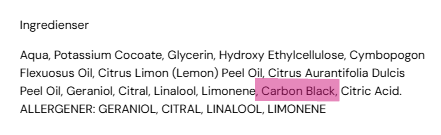
A Danish brand sells a liquid soap with “Activated Charcoal” on the label. The product description explains in detail how the charcoal has been treated with steam and carbon dioxide at 700 to 900 degrees Celsius and has a microporous structure that works to cleanse.
The INCI shows Carbon Black.
Carbon Black and activated charcoal are two different substances. Activated charcoal is porous carbon from organic material — wood, coconut shells, bamboo — that’s what binds impurities. Carbon Black is an industrial pigment made by incomplete combustion of petroleum. It’s used in tires and mascara. It’s pigment, not activated charcoal.
Turn the bottle over. On the body-scrub label it says “CI 77266”. On the liquid soap it says “Carbon Black”. Two spellings — same substance: a synthetic pigment from petroleum cracking, according to EU CosIng. Not activated charcoal.
Both products are marketed as “Activated Charcoal” with a detailed description of treatment at 700 to 900 degrees and a microporous structure. It’s not a one-off mistake — it’s practice. According to the INCI, there is no activated charcoal in those products.
Here’s how you spot it: When a product promises “activated charcoal,” look for Charcoal Powder, Activated Charcoal, Carbo Activatus, or E153 in the INCI.
Carbon Black or CI 77266 alone is pigment.
At the drugstore you find a soap in the category “Vegan Hand Soap.” You think: vegan equals no animals.
The INCI contains CI 75470 — that is, Carmine. Carmine is a red pigment made from crushed cochineal scale insects. Roughly seventy thousand insects per kilo of carmine.
The manufacturer is the same as above. The retailer is the drugstore, Denmark’s largest beauty retailer. Both have marketed the product as vegan. No one checked.
It’s not a one-off. Same manufacturer — another vegan-labelled soap bar — another animal ingredient. Meet Soap Birch.
EU CosIng defines the substance as a fine black powder obtained by burning animal bones in a closed container — derived from calcined cattle bones.
Here’s how you spot it: When something is labelled vegan, search for CI numbers you don’t recognize plus “animal.” Especially CI 75470 — that is, Carmine — CI 77267 — that is, Bone Black or Charcoal Bone — and guanine, that is, Pearl Essence, are classic hidden animal ingredients in otherwise vegan-labelled products.
A popular Danish stain-remover bar has this so-called INCI on its webshop. And this is a website that markets itself on handmade soap — made in their own soap factory. It reads: anionic surfactants over thirty percent, non-ionic surfactants under five percent, fragrance under five percent, and limonene.
That’s not INCI. It’s a detergent declaration under EU Regulation 648 from 2004, used on cleaning products. It lets the manufacturer hide which surfactants they use — just percentage ranges of categories.
You can’t tell whether “anionic surfactant over thirty percent” is Sodium Cocoyl Isethionate, Sodium Lauryl Sulfate, or something else entirely. That’s the manufacturer’s choice.
Here’s how you spot it: If the ingredient list consists of function categories — surfactants, emulsifiers — instead of specific named substances, the product is probably classified as a cleaning product — not cosmetics. You have fewer rights to ingredient information.
On the drugstore’s website there’s this disclaimer: There may be small discrepancies between the content above and the ingredient declaration on the item you receive as a customer. We therefore recommend that you always check the ingredient declaration on the physical product.
In other words: the drugstore doesn’t guarantee that its own INCI is correct. The responsibility is the customer’s.
It’s probably the most honest moment in this entire setup — and the clearest illustration of why eight out of ten consumers are lost.
So you go back to the producer’s own webshop to find the real INCI. You find the same products as at the retailers — Soap Birch, Dream Fragments, Liquid Soap Activated Charcoal. The result at the manufacturer: no INCI anywhere. Only marketing copy, price, and a short list with “Made in Denmark” and “Suitable for vegans.”
The drugstore shows an INCI with a disclaimer. The manufacturer shows nothing. As a consumer you’re left holding a package in your hand — and the law says you can only read the INCI once you’ve already bought the product.
Next time you’re standing with a product in your hand, check five things.
First: Does the list start with several A-words in a row? Then it’s alphabetical, not INCI.
Second: Does the marketing promise a specific function? Find that ingredient name in the INCI. If it’s not there with a specific name, it’s not in the product.
Third: Does it say “vegan” on the label? Search for INCI numbers you don’t recognize plus “animal” — especially CI 75470, CI 77267, and guanine.
Fourth: Are you getting categories instead of ingredients, like “surfactants over thirty percent”? Then it’s a detergent declaration, not cosmetics.
Fifth: Compare the INCI on the manufacturer’s page and the retailer’s page for the same product. If they’re different, one of them has an error. Ask which.
There are also tools you can use. The Kemiluppen app from the Danish Consumer Council, where you scan barcodes and get an assessment. INCIdecoder.com, where you look up ingredients in English. The CosIng database, which is the EU’s official ingredient database. And you can send an email to the manufacturer’s customer service and ask for the full INCI as it appears on the physical package. If they don’t reply within seven days, that’s an answer too.
If you’ve ever thought “I really ought to read the ingredients, but I won’t understand them anyway” — then you’re right. You don’t understand them, because the system doesn’t want you to. Eight out of ten is not a personal weakness. It’s a design decision.
You have tools now. Use them. Ask manufacturers stupid questions — they deserve them. And don’t give up because it’s hard. It’s hard on purpose.
Sources
- Opinion-undersøgelse for Svanemærket (januar 2026, 1.010 danskere 16+): Forbrugerne famler i kemijunglen — hair.dk
- YouGov-undersøgelse for Gjensidige (23. april 2025): Skjulte farer i din hudpleje — Gjensidige/Ritzau
- Samme undersøgelse omtalt i: Mariagerfjordposten
- Elou — Sådan læser du ingredienslisten (INCI-guide)
- Svanemærket — kriterier for kosmetiske produkter
- Miljøstyrelsen — faktaark om mærkning af kosmetik
- Miljøstyrelsen — faktaark om vildledende markedsføring af kosmetik (Kosmetikforordningen Art. 20)
- COSMILE Europe — CI 77266 (Carbon Black)
- EU Cosmetics Regulation 1223/2009 Art. 19
- EU Detergent Regulation 648/2004
- Forbrugerrådet TÆNK Kemi — vejledning
- CosIng — EU’s officielle database over kosmetiske ingredienser (definerer alle INCI-navne og stof-beskrivelser)