
Do you know what’s in your bottle? And I mean… do you actually know.
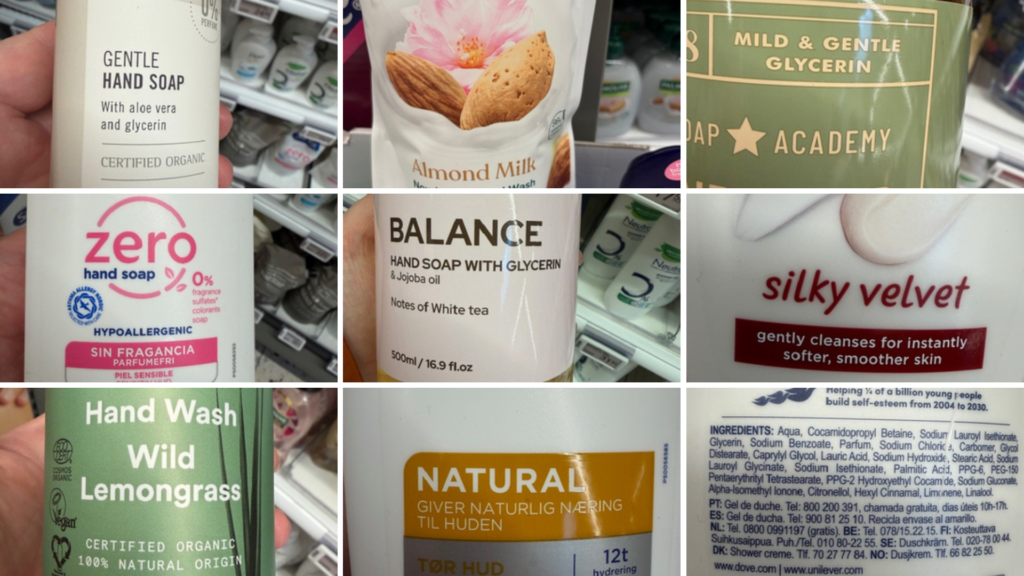
We took a few random bottles off the shelf. Hand soap and shower gel. The bottles standing in your bathroom right now. And we turned them over.
The front labels were full of promises: “Natural.” “Ninety-five percent natural origin.” “Zero percent sulfates.” “Certified Organic.” “Mild and Gentle Glycerin.” “With Jojoba oil.” “Balance.” “One hundred percent Natural Origin.” “For people who care.”
The back labels told a different story.
P.S. If you want to repeat the experiment, bring glasses. Some of those lists are nearly illegible. I wonder why.
Here’s what we found.
Palmolive writes “Naturals” and “ninety-six percent natural origin.” Water counts as natural origin. Behind the words: Sodium Laureth Sulfate. Parfum. Hexyl Cinnamal… also a fragrance, but classified as an allergen in the EU. That’s why it can’t hide behind “Parfum” anymore. It has to be declared separately.
But what good does that do if you don’t turn the bottle over.
They could write asbestos on it, and you’d never notice. Asbestos, by the way, is also natural.
Sanex writes “Natural” and “zero percent sulfates.” The asterisk leads to a footnote. Ingredient number two: Sodium C14-16 Olefin Sulfonate… a synthetic surfactant that does exactly the same thing as SLS. They removed the word. Not the chemistry.
The Soap Academy writes “Mild and Gentle Glycerin” in large print. Ingredient number two: SLS. Number five: Cocamide DEA. Glycerin is number seven… after everything that’s neither mild nor gentle.
Derma writes “Certified Organic” and “ninety-nine percent natural origin.” Twenty percent is organically grown. The only organic ingredient is Aloe Barbadensis Leaf Extract… aloe vera. So aloe vera makes up twenty percent of the bottle. Fifty milliliters out of two hundred and fifty.
It sounds good. Until you ask: what is an aloe vera extract?
It’s water that has run over an aloe vera plant. The extract itself is ninety-five percent water. So those fifty milliliters of “organic aloe vera” are really forty-seven milliliters of water and three milliliters of aloe. Add that to the water already listed as ingredient number one… and the bottle is nearly ninety percent water.
And the aloe vera that’s actually there? You rinse it off after fifteen seconds.
Urtekram does the same thing… but smarter. They write “eleven percent organic of total” on the back. Eleven sounds low, so they add a line: “forty-three percent organic of total minus water and minerals.” It’s the same number. They’ve just removed the water from the equation to make the percentage look better. It’s like saying: “I’m one hundred percent muscle… if you don’t count fat, bone, and water.”
And at Urtekram, six ingredients share those eleven percent. Aloe vera maybe gets seven percent of the bottle. That’s about twenty-one milliliters of extract… most of which, again, is water. Actual aloe vera bioactives: around one milliliter. In a bottle of three hundred milliliters.
Water and salt are “natural origin.” Aloe vera extract is water with a fancier name. And the front says “one hundred percent Natural Origin.”
That they have thirty ingredients is a whole other conversation. But hey, it’s green.
But one bottle shouted “authenticity” louder than all the others.
Transparent bottle. Golden contents. Minimalist label. “Balance.” “Hand Soap with Glycerin and Jojoba oil.” “Notes of White tea.”
It’s called Urban Spa. And it looks like something you’d find in a store that only sells things with cork stoppers and canvas totes.
Everything about it says: there’s nothing to hide here.
Turn it over.
Ingredient number two: Sodium Laureth Sulfate. SLS.
Number ten: DMDM Hydantoin. A preservative that slowly releases formaldehyde. I’ll spare you the chemistry lecture and just say… it’s classified as carcinogenic by the WHO… in the same category as asbestos.
Number eleven: Phenoxyethanol. Another preservative.
Number twelve: Jojoba oil. The oil on the front. After the formaldehyde releaser. After Phenoxyethanol. There’s more preservative in that bottle than jojoba.
Number thirteen: Parfum. Behind that one word hide fragrance compounds not declared individually.
Numbers fourteen and fifteen: Benzyl Benzoate. Hexyl Cinnamal. Two allergenic fragrance compounds… declared separately, because the EU requires it. Three layers of fragrance in a soap that says “Notes of White tea.”
Number sixteen: CI 19140. An artificial dye. Dead last on the list… the smallest amount in the bottle. But it’s what gives it the golden color. The one that makes the bottle look like pressed jojoba. One drop of artificial dye shapes your entire first impression.
Bottom right… in small print: “Made in PRC.” People’s Republic of China. That’s how you write “Made in China” without writing it. Now you know that too.
Scandinavian design. Chinese factory. And an ingredient list that contradicts everything the front promises.
But I’m not done yet.
Dove Silky Velvet has twenty-two ingredients, PPG-6, and five synthetic fragrance compounds. But Dove looks industrial. It doesn’t hide. You already suspect it.
Urban Spa hides. It looks like honesty. It looks like transparency. And that’s exactly why it’s more dangerous… because you don’t turn it over.
All of it came from one local Danish supermarket. Not from some Turkish greengrocer selling something imported from outside the EU. One supermarket. One shelf. Twenty minutes.
The INCI list doesn’t lie.
INCI… International Nomenclature of Cosmetic Ingredients… is the legally required ingredient list. The order is by amount. Most first. It’s regulated by the EU. And it’s the only place on the entire bottle that isn’t advertising.
The front is marketing. The back is law.
Next time you’re standing in the supermarket: turn the bottle over. Read. Not the front… it’s made to sell. Read the back. It’s made to comply with the law.
That’s where the truth is.