
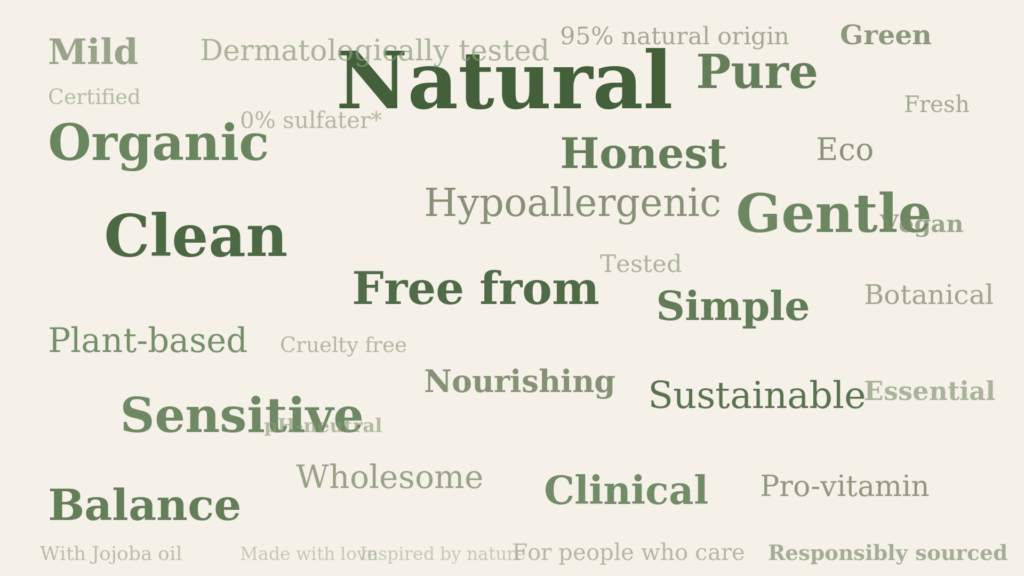
“Natural” is not a protected term.
There’s no law defining what “natural” means on a bottle. No authority that approves it. No oversight. The word is free to use — and the industry knows it.
The EU Cosmetics Regulation governs whether a product is safe. It doesn’t govern whether it’s honest. Safe and honest are not the same thing. A product can be safe and still lie to you with the front of the pack.
Marketing law prohibits misleading claims — but “natural” is so vague that it’s almost impossible to call it misleading in a legal sense. There’s no standard to measure against. Nothing to break.
So they write it. On everything.
There’s one place you can check. It’s called INCI — International Nomenclature of Cosmetic Ingredients. It’s the legally required ingredient list on the back. It’s regulated. The order is by quantity… most first. So the further down, the less there is of it. And it doesn’t lie, because it isn’t allowed to.
The front is advertising. The back is law.
And when you turn the bottle over, it looks different.
One example… Palmolive Naturals with “ninety-six percent natural origin” on the front. Turn it over. Ingredient list: SLS. Parfum. Hexyl Cinnamal. Limonene. Linalool.
Ninety-six percent natural origin — because water counts. Water is natural. Soil is natural. Asbestos is natural. The word is meaningless without context.
Another example… Sanex Natural with “zero percent sulfates” — with an asterisk. The asterisk is the interesting part. It leads to an explanation that they use sulfate-free surfactants. But ingredient number two — after water — is Sodium C14-16 Olefin Sulfonate. A synthetic surfactant that functions exactly like SLS. They removed the word “sulfate.” Not the chemistry.
A third… Urtekram with “one hundred percent Natural Origin” plus “eleven percent organic of total.” Eleven percent organic. Eighty-nine percent is not. But that’s on the back — in small print. The front says something else.
Derma Eco says “ninety-nine percent natural origin” — again, water is “natural origin.” Twenty percent is organically grown. Eighty-nine percent is not. But ninety-nine percent looks good on the front.
The INCI list is legally required and precise. But it has one blind spot… the word “Parfum.” One word. Behind it hide potentially hundreds of synthetic scent compounds, stabilizers, and substances that the Danish Environmental Protection Agency warned about in January 2025 — specifically in children’s bath products.
Parfum is the curtain on the ingredient list. You can see something is hanging there. You can’t see what.
Our ingredient list? A handful of oils… beef tallow, coconut oil, olive oil, shea butter. Depending on which soap you’re looking at. Distilled water. Glycerin.
Few ingredients, all of which can be eaten in their original form. The glycerin isn’t added — it’s naturally created in the process. None of them needs an asterisk, a footnote or an explanation in small print. None of them is “natural origin” — they are the ingredients. You don’t call wool socks “natural origin” either — that’s a given.
There’s no front that tells one story and a back that tells another.
We don’t write “natural” on our soap. Not because it isn’t — but because the word doesn’t mean anything anymore.