
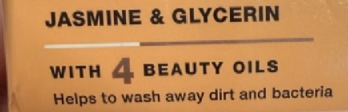
I was out doing research for another post and noticed that a lot of the hard soaps on the supermarket shelf had it right on the front… “With glycerin,” “Contains glycerin,” “Now with glycerin.”
That actually made me pause.
In my world it’s a bit like writing on a bag of spaghetti… “Now with flour.” Or “Contains fiber” on a bag of oats.
You’re not in my world, so you probably don’t know this — glycerin is just as natural a part of a hard soap as flour is in a bag of spaghetti. Or the yolk in an egg. It’s built in, so to speak.
So as I stood in the supermarket looking at those soaps with “With glycerin” on the front, I thought… why are they writing that on the front?
Glycerin is on the ingredient list. It has to be — that list has to name everything. In small print. In descending order. But the front? The front is advertising. You only write it there if the ingredient isn’t a given.
But glycerin is a given in soap — so why brag about it?
Unless it isn’t there on its own. And it turned out it isn’t.
Turn your soap over. The two soaps are sitting in a perfectly ordinary supermarket. In Denmark. Look at the ingredient list. You’re looking for one thing… Sodium Chloride. Salt.
Salt is not part of saponification. It’s there for one reason… it was used to pull the glycerin out.
The technique is called salting out. You add salt to the raw soap mass. The glycerin dissolves into the brine, separates from the soap, and is drained off. The process is repeated to extract as much as possible.
The glycerin is sold on. And a little — not all of it — is added back to the soap.
There’s simply no reason to pull it out just to put all of it back in again — that’s an extra process and therefore an extra cost.
What is glycerin? Glycerin is a humectant. It attracts water and holds it in the skin. It’s what keeps skin from feeling tight after washing, and moisturized without body lotion.
It’s the third most-used ingredient in cosmetics — surpassed only by water and fragrance. A global market worth billions.
Your moisturizer. Your lip balm. Your body lotion. Your sunscreen.
Glycerin is everywhere — and demand is so high that you can earn triple on it… you sell soap with a fraction of the glycerin left in it, you sell glycerin alongside it, and afterward you sell a body lotion.
Because it doesn’t stop there. Missing glycerin isn’t the only thing that leads to dry skin. The salt used to pull the glycerin out also dries the skin further. So you’re missing the glycerin — and the salt makes it worse. Then in comes the body lotion.
This does not apply to genuine wellness soap with added sea salt, for example, because when you work with a real soap process, the amount of natural glycerin is enormous, and you can also compensate for the salt’s effect in other natural ways. But then it also says “With sea salt” on the front, not “With glycerin.”
Where else does glycerin come from? Saponification is the oldest way to make glycerin. But demand long ago outstripped what soap production can deliver.
Biodiesel is the biggest source today. But glycerin from there is heavily contaminated with methanol, salt and fatty acids. Purifying it costs seventeen hundred to three thousand five hundred kilos of CO2 per ton — the equivalent of three to seven return flights from Copenhagen to Turkey. To purify glycerin.
The other route is synthetic, from crude oil. Here you start with propylene — a petroleum product — and run it through chlorination and oxidation until you end up with glycerin. Completely synthetic. In the nineties, thirty percent of all glycerin in the US was made this way.
Two routes. One starts with palm oil and leaves methanol behind. The other starts with crude oil and runs through a chemistry lab.
We run cold-process. Fat, lye, water. Saponification produces glycerin, and the glycerin stays in the soap.
That’s why our soaps are a bit sticky and slick when they’re wet. It’s total glycerin overload.
We don’t brag about it either.
It’s not a feature. It’s a given.
And now you know it too.
Sources
- Classic Bells, “Glycerin in Soap”
- Wikipedia, “Saponification”
- Ingredi, “Glycerin: The Most Frequently Used Cosmetic Ingredient After Water”
- PMC, “Glycerol Production and Transformation” (2017)
- Journal of Cleaner Production (ScienceDirect), miljøpåvirkning af sæbeproduktion (2023)
- GreenMatch, “Så meget bruger du i CO2 når du rejser” (2016)
- Stench Soap, “What’s the Deal with Glycerin in Soap and Why We Keep It In”