
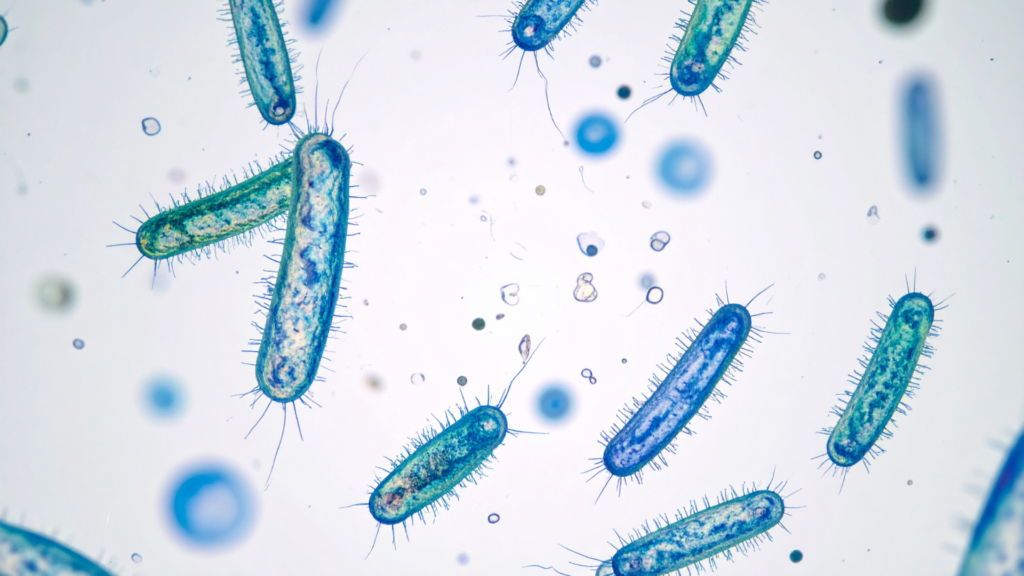
You’ve heard it your whole life. Wash your hands. Kill the bacteria. Buy the antibacterial soap. The one with Triclosan. The one with “antibacterial soap” on the label.
But soap never needed to kill anything. It does something better.
Soap is simple chemistry. A soap molecule has two ends… one that loves water, and one that loves fat. When you wash your hands, the fat-end binds to dirt, oil and bacteria on your skin. The water-end binds to the water from the tap.
The bacteria are lifted off. They lose their grip on your skin, gather into little clusters called micelles, and are rinsed away with the water. Soap’s fat-ends can even penetrate the cell membranes of bacteria and break them open — that’s documented by Yale School of Medicine.
The soap grabs the fat. The water grabs the soap. And takes it all with it.
No chemical warfare. Just physics and chemistry that have worked for millennia.
In 2800 B.C., the Babylonians mixed fat with ash and water. They scratched the recipe into clay cylinders… “fat boiled with ash.” That’s the oldest documented soap-making in the world.
Ever since, humans have washed with variations of the same recipe. Romans. Vikings. Medieval soap-makers. Coal miners. Soldiers in two world wars. Synthetic surfactants like SLS didn’t exist before the thirties. Before that, there was only fat, lye and water. And it was enough.
None of them had a pump bottle with “antibacterial” on it. They survived anyway.
Not because they were immune. But because soap — ordinary soap — does exactly what it’s supposed to. It removes what doesn’t belong. The rest, your body handles itself.
So what was Triclosan? Triclosan was the substance that made soap “antibacterial.” It was added to liquid hand soaps, dish soaps and toothpaste for decades. Marketed as the extra layer of protection.
In 2016, the American FDA banned nineteen antibacterial substances — including Triclosan — in consumer soaps. The reason? Manufacturers couldn’t document two things. First, that antibacterial soap was more effective than ordinary soap. Second, that it was safe for daily use.
Animal studies showed hormone disruption. Research pointed to reduced sperm quality, effects on the heart and the thyroid gland. And the most important point… bacterial resistance. Triclosan trained bacteria to survive.
In the EU, the rules were tightened in 2024. From October 2025, Triclosan is further restricted in cosmetic products on the European market.
The FDA’s own website says it plainly… “Skip the antibacterial soap. Use plain soap and water.”
An NIH-funded study led by Elaine Larson of Columbia University — the first double-blind, randomized clinical trial of its kind — compared antibacterial soap with ordinary soap in two hundred and twenty-two households in New York. The result… no difference.
A systematic review of twenty-seven studies confirmed the same. Soaps with Triclosan at the concentrations normally used in consumer products — zero point one to zero point four five percent — were no more effective than ordinary soap at reducing bacteria on the hands or preventing illness.
The Mayo Clinic sums it up briefly… “Regular soap is just as effective.”
Your skin is not a battlefield. Your skin has a microbiome. Billions of bacteria, fungi and microorganisms living in an ecosystem on your body. Most are harmless. Many protect you.
A study from 2018 showed that antibacterial soap changes the composition of the skin’s microbial community — and that the changes persisted for at least two weeks after people stopped using the soap. You’re not just washing off dirt. You’re resetting an ecosystem.
Ordinary soap removes what sits loosely. Antibacterial soap goes after everything — including what protects you.
And what about smell? Most people don’t think about bacteria when they see a stain. Stains are visual. Soap handles those just fine.
But smell — that’s something else. Smell in clothes, on skin, in shoes — it comes from bacteria breaking down sweat and organic matter. And here many people think the solution is to kill the bacteria. The spray can. The disinfectant. The chemistry.
But there’s another way. Activated charcoal adsorbs. It doesn’t kill. It captures.
One gram of activated charcoal has a surface area of five hundred to fifteen hundred square meters — the equivalent of several tennis courts. That surface is packed with micropores that physically bind odor molecules… sulfur compounds, ammonia, organic acids. The molecules bacteria leave behind as waste.
Soap removes the bacteria. Charcoal removes what they left behind.
No fragrance to drown it out. No chemical to mask it. Just a porous structure that pulls the odor out — molecule by molecule.
Next time you stand in front of the shelf, turn the bottle over. Read the ingredient list.
If it says Triclosan, Triclocarban, Benzalkonium Chloride, or other antibacterial substances… you’re paying extra for something that works no better than soap. And that potentially does more harm than good.
If the ingredient list is longer than your shopping list… ask yourself what those extra fifteen ingredients do that fat and lye can’t.
Soap is four thousand eight hundred year-old technology. It works. It has always worked. It doesn’t need an upgrade. It just needs to be soap.
Sources
- Yale School of Medicine: “Why Soap Works”
- American Cleaning Institute: “Soaps & Detergents History”
- The Archaeologist, 2024: “The Invention of Soap in Ancient Babylon”
- Chagrin Valley Soap: “Sodium Lauryl Sulfate: What the Science Reveals”
- FDA, 2016: “Safety and Effectiveness of Consumer Antiseptics”
- FDA: “Skip the Antibacterial Soap; Use Plain Soap and Water”
- Cleveland Clinic: “Triclosan: What It Is & Effects”
- NPR, 2016: “FDA Bans Triclosan And 18 Other Chemicals”
- Infection Control Today: “NIH-Funded Study — Antibacterial Soap No Better”
- Mayo Clinic: “Regular Soap Just as Effective”
- PubMed (Aiello et al., 2007): “Consumer antibacterial soaps: effective or just risky?”
- PLOS ONE (Yu et al., 2018): “Antibacterial soap use impacts skin microbial communities”
- PMC (The Florence Statement, 2017): “Triclosan and Triclocarban”
- Obelis, 2024: “EU Cosmetics Deadlines: Triclosan Bans 2025”
- PMC, 2022: “Skin Cleansing without or with Compromise”
- EPA: “Odor Removal from Air by Adsorption on Charcoal”
- Hey Carbons: “Activated Carbon for Odor Removal”