
You’ve seen it.
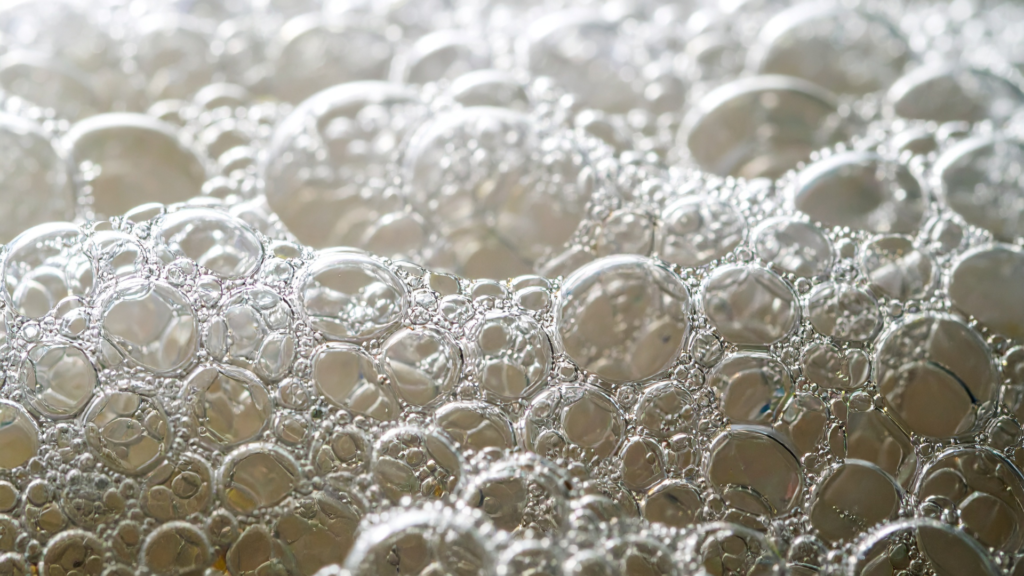
Foam from a liquid soap… big, airy, impressive for three seconds — and then it’s gone. Left behind is a thin film and the feeling of having washed with nothing.
Foam from a cold-process soap… denser, heavier, slower. It stays where you put it. It doesn’t slide off your hand. The bubbles don’t just vanish.
That’s not random. That’s chemistry.
What is foam, really? Foam is air trapped in a thin film of water and soap molecules. Every bubble is a sphere of air wrapped in a double wall — two layers of soap molecules with water in between.
When the foam “holds,” it’s because that wall is strong. When it collapses, it’s because the wall is weak. The whole difference sits in that film.
The technical term is drainage — the speed at which water runs out of the bubble walls. Low drainage means thicker walls and foam that stays. High drainage means thin walls and foam that disappears.
Soap is fat plus lye. Which fatty acids you start with determine which soap molecules you end up with. And those molecules behave very differently in a bubble wall.
Lauric acid — the dominant fatty acid in coconut oil — has a short chain. It gets going fast. It creates big, beautiful bubbles right away. But the chain is too short to pack tightly in the bubble wall. The bubbles are large and airy. And they collapse quickly.
Stearic acid and palmitic acid — the dominant fatty acids in beef tallow — have long chains. They pack tightly. Think brickwork instead of loosely stacked gravel. The bubble walls become thicker, tougher, more resistant.
Peer-reviewed research confirms it. Shorter chains create rapid foam formation, but longer chains improve foam stability by forming a more rigid film around the air bubbles — a film that’s harder to break.
That’s why beef tallow and coconut complement each other in a soap. Coconut starts the party. Tallow keeps it going.
Here’s another difference you can’t see… glycerin.
Glycerin is hygroscopic — it binds water. In a bubble wall that means the water doesn’t run out as fast. The wall stays thick. The bubbles live longer.
In a cold-process soap — like ours — the glycerin stays in the soap. It’s a natural by-product of saponification. Eight to twelve percent of the finished soap is glycerin.
In industrial soap production, the glycerin is removed and sold separately. It’s called salting out… salt is added, the soap floats up, the glycerin sinks into the brine and is drawn off.
The result is a soap without the very component that would have kept the foam stable — and your skin moisturized.
The glycerin ends up in moisturizers, serums and lotions. You buy it back in another bottle.
And what about SLS? The foam you know from liquid soap and shampoo doesn’t come from fat and lye. It comes from synthetic surfactants — typically Sodium Lauryl Sulfate, SLS.
SLS is an anionic surfactant. It creates big bubbles quickly and efficiently. But like other anionic surfactants, it has thin bubble walls, fast drainage and poor stability. The foam looks like a lot. It doesn’t last.
It’s designed to look clean, not to hold.
Next time you work up a lather, notice it.
Does the foam vanish immediately? That’s short chains, removed glycerin, or synthetic surfactants doing exactly what they’re designed to do… impress for three seconds.
Does the foam stay? Then it’s long fatty-acid chains, glycerin binding water in the bubble walls, and a saponification process that hasn’t removed what belongs there.
Foam isn’t just foam. It’s a visible consequence of what the soap is made of — and what has been taken out.
Sources
- MDPI Processes, “Towards a Deeper Understanding of Simple Soaps” (2025)
- ScienceDirect, “Foam Stability” (encyclopedia topic)
- ScienceDirect, “Foam Drainage” (encyclopedia topic)
- Cambridge University Press, “Bubble and Foam Chemistry — Soap Bubbles and Thin Films”
- Classic Bells, “Soap Calculator Numbers”