
Your great-grandmother had one soap and a clean home. You have a whole cabinet and a dermatologist. The answer starts with three letters… SLS.
How did that happen?
In 1934, Procter & Gamble introduced “Drene” — the first shampoo built on synthetic surfactants instead of soap. Sodium Lauryl Sulfate — SLS — quickly became the industry standard.
Not because it washed better than soap. Because it foamed more. Dramatic, convincing, photogenic foam. And because it came in a bottle.
Suddenly soap in your hair was “old-fashioned.” The bottle was the future.
In 1980, the Minnetonka Corporation launched “Softsoap” — the first liquid hand soap for the mass market. Twenty-five million dollars in six months. The man behind it cornered the supply of plastic pumps, so no one could copy him for the first year.
Colgate-Palmolive bought him out in 1987. By the nineties, liquid soap was the norm. The bar was “that thing going soft in the soap dish.”
The bottle won. Not because what was inside was better. Because the format was easier to sell.
SLS is a surfactant. It washes. One molecule with an end that loves water and an end that loves fat. It lifts grease off surfaces and rinses it away. Real chemistry, and it works.
The problem isn’t that SLS doesn’t work. The problem is that it works too well.
SLS strips all the fat. Including the fat your skin produces to protect itself. It breaks down the skin barrier — skin loses moisture from within, gets irritated, and compensates. So you wash again. And the cycle continues.
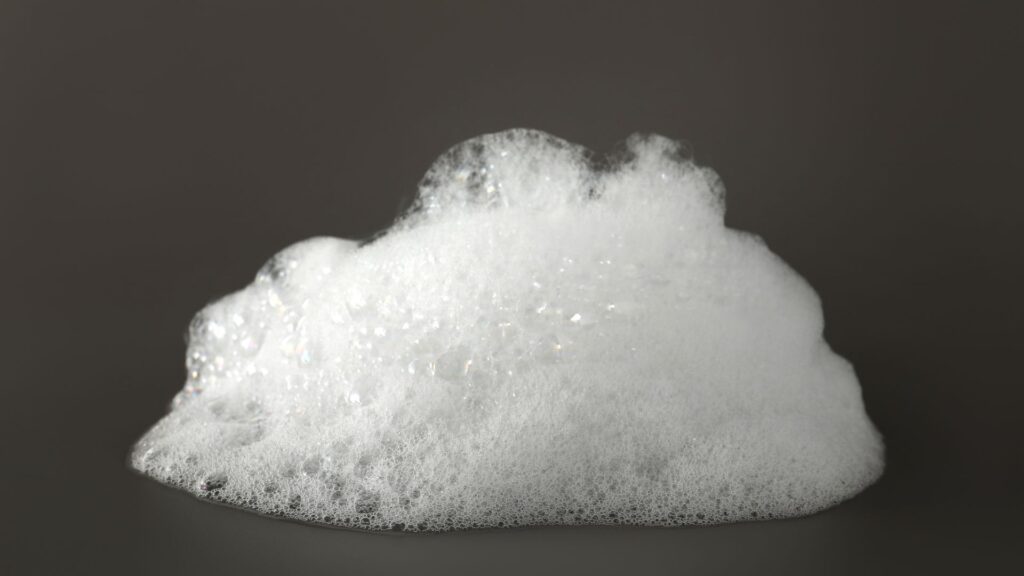
And the foam? The foam is a by-product. It helps spread the product around — but the foam itself doesn’t clean. It’s just visible. And we’ve been raised to believe that visible foam equals clean.
No foam? Then it probably isn’t working. That’s not science. That’s conditioning.
SLS isn’t alone. Turn over a bottle of liquid soap, shampoo or body wash and read the ingredient list.
SLES — milder than SLS, but the same mechanism. Cocamidopropyl Betaine — marketed as “mild” and “natural,” crowned Allergen of the Year in 2004. Sodium Cocoyl Isethionate — the new favorite in “natural” soap bars, still synthetically produced.
What they have in common… they’re designed to remove fat. And your skin is covered in fat — on purpose.
Every year, an association of American dermatologists names one substance “Allergen of the Year.” Not because it’s the most dangerous. But because no one is talking about it.
Let me name a few of the winners.
2004… Cocamidopropyl Betaine. The “mild” surfactant in your shampoo and body wash.
2007… Fragrance. One word on the ingredient list. Hundreds of substances behind it.
2013… Methylisothiazolinone. A preservative in shampoo, body wash, wet wipes and paint.
2018… Propylene Glycol. In your shampoo, conditioner, cream — and in antifreeze.
2019… Parabens. In creams, makeup and skincare. The ones you thought were harmless.
2023… Lanolin. In lip balm and moisturizer. It comes from sheep’s wool.
The pattern is hard to miss. Year after year, the winners are substances sitting in your everyday products. Not industrial waste. Not chemicals from a factory you’ve never seen. Things on the shelves at the drugstore.
Fifteen million tons of surfactants are used globally each year. Sixty percent ends up in the water environment. That’s not a drop in the ocean. It’s the ocean.
Treatment plants aren’t designed to handle synthetic surfactants. They remove bacteria and organic matter. The surfactants pass straight through — or disrupt the treatment process directly.
Some surfactants break down in water into substances that mimic estrogen in fish. Lowered testosterone, reduced fertility, disrupted reproduction. Documented in peer-reviewed studies. The substances accumulate — they don’t disappear.
“Biodegradable” sounds reassuring. The OECD standard requires a product to break down by sixty to seventy percent within twenty-eight days — under perfect laboratory conditions. Not your local treatment plant. Not the Øresund strait in January.
And a product is only as biodegradable as its least biodegradable ingredient. A degradable surfactant mixed with a substance that practically never disappears does not make a degradable product. It makes a green stamp.
“Fragrance” is the curtain on the ingredient list. You can see something is hanging there. You can’t see what’s behind it. Behind that one word hide synthetic scent compounds, stabilizers, and substances that the Danish Environmental Protection Agency warned about in January 2025 — specifically in children’s bath products. That’s not a blogger shouting. That’s a national authority.
Two percent of all microplastic in the oceans comes from personal care and cleaning products. That doesn’t sound like much — but it’s two percent of millions of tons. It doesn’t disappear. And it was the straws that took the heat.
Why do you have a bottle for every purpose? Follow the money.
One soap bar for everything is one transaction. Shampoo, conditioner, body wash, hand soap, face wash and shaving foam are six transactions. Times millions of households. Times every sixth week. And that’s only personal care. Cleaning comes on top.
It was never a question of hygiene. It was a question of business.
It started with a bottle in 1934. It ended with a whole cabinet.
Your great-grandmother’s brown soap… fat plus lye. It rinses off. It breaks down. Done. No surfactants slipping past the treatment plant. No fragrance hiding behind one word. No substances accumulating in fish.
We make soap. Fat, lye, water. It foams. It cleans. It doesn’t strip. And when it hits the drain, it’s just soap.
Sources:
- Smithsonian / National Museum of American History: Royal Drene Shampoo
- Wikipedia: Softsoap
- Wikipedia: Allergen of the Year
- Freitas et al., Advances in Colloid and Interface Science, 2021: Effect of synthetic surfactants on the environment and the potential for substitution by biosurfactants
- OECD Test No. 301: Ready Biodegradability
- Pew Charitable Trusts, 30. marts 2021: Microplastics Are a Big and Growing Part of Global Pollution
- Miljøstyrelsen, januar 2025: Dit barns badeprodukter er fyldt med parfume