
You’re through. You’ve reset. You’ve survived the first four weeks. You’ve avoided the wrong pairings. You’ve figured out what works for your hair — and what doesn’t.
And now you wash with soap and rinse with vinegar. Two steps. That’s it.
It might feel like an achievement. And it is — in 2026. But for the rest of human history, it was just Tuesday.
Everyone knew it. The Navajo, the Hopi, and the Apache — North American tribes — washed with yucca root. The plant contains saponins — nature’s own surfactants. They lather. They clean. They don’t strip. No transition period. No carousel. The long black hair we see in films isn’t a director’s creative preference. They genuinely had enviable hair.
Japanese women in the Heian period had hair down to the floor. They rinsed with rice water — starch that smoothed the cuticle. No silicone. No serum for three hundred and forty-nine kroner.
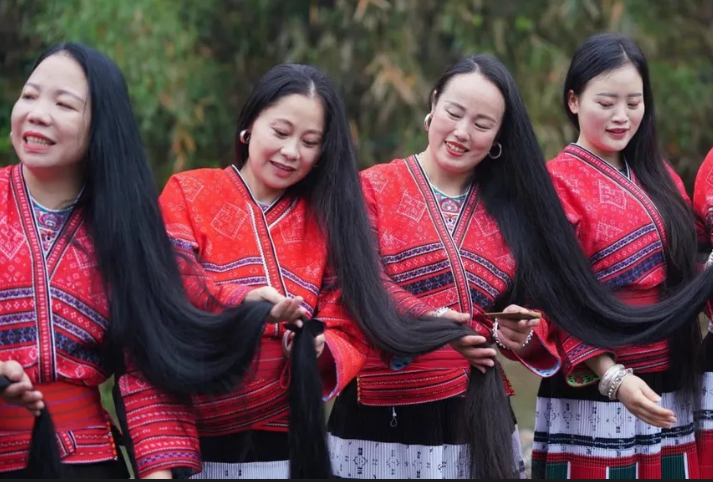
Yao women in China still exist to this day. They wash with fermented rice water — not just rice water, but fermented. They have shiny, strong hair with few gray strands well into old age. You might think “genes,” but genes won’t save you from your daily choices. Not in the long run.
In West Africa, women used shea butter to protect their curly hair — because they knew that sebum doesn’t travel down the curves on its own. No conditioner. Just fat and understanding.
In Europe, people washed with soapwort. In the Middle East, with olive soap. In India, with shikakai and reetha.
Everyone figured it out. Different plants, different fats, different cultures — but the same principle: clean gently, add fat, let the scalp do its job.
Your great-grandmother washed with soap made from real fat. Rinsed with vinegar. Brushed a hundred strokes in the evening. Her transition period was zero days — because there was nothing to switch from.
SLS was introduced in the nineteen-thirties. Liquid soap in 1980. Silicone conditioner in the nineteen-fifties. The whole system you’ve just spent four weeks unlearning is younger than your great-grandmother or grandmother.
It’s not soap that’s the alternative. It’s SLS.
What’s different now? You wash less often. Not because you decide to — but because the hair doesn’t get greasy as fast. The scalp produces what it needs. No more. You can spend your time on something else.
You use two things. Not seven bottles. You can spend your money on something other than Olaplex.
Your hair feels different. Not “silky-smooth” — that was silicone, and it’s gone. But alive. With the texture your hair actually has — not the one that was laid on top. Now you actually have healthy, naturally shiny hair. Not a made-up corpse — pun intended — the hair is dead, after all.
And the hair that grows out now starts in a scalp that isn’t stripped, isn’t overproducing, and isn’t wrapped in plastic. Now your genes can actually unfold in their full expression.
You don’t get to decide over the dead. You decide over the new. Give it peace. Give it time.
Your great-grandmother knew it. Navajo women knew it. Japanese women knew it. They just didn’t call it anything.
It’s not rocket science. It’s the opposite. It’s the simplest thing in the world — that we forgot for ninety years.
Sources
- Tallow, Rendered Animal Fat, and Its Biocompatibility With Skin: A Scoping Review, PMC, 2024
- The Shampoo pH can Affect the Hair: Myth or Reality?, International Journal of Trichology, 2014
- Lorraine Massey, Curly Girl: The Handbook, Workman Publishing, 2001