
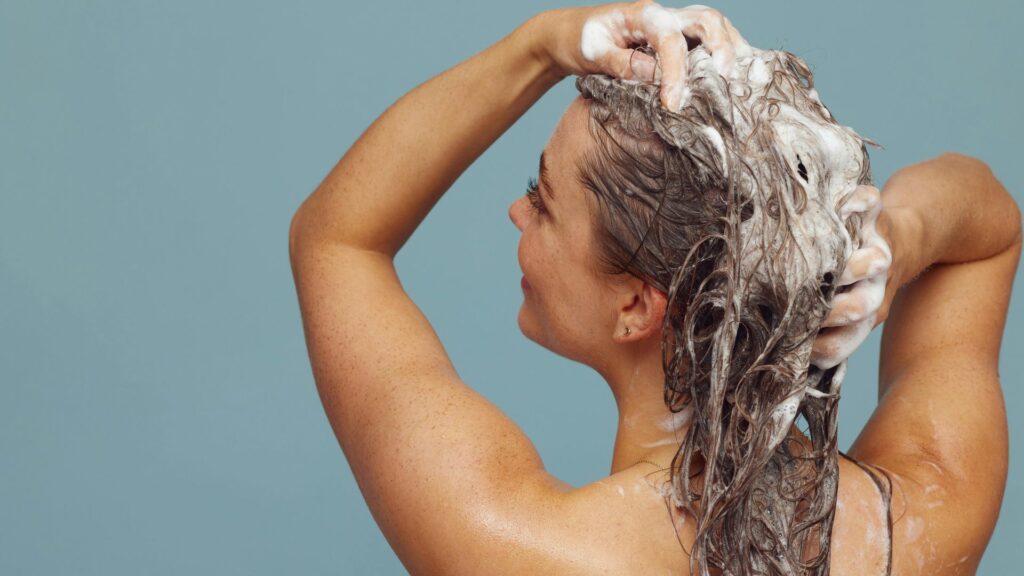
You’re still here. Good. Welcome to the reset.
Before you touch a bar of soap, we need to talk about what’s already sitting in your hair.
The most important question isn’t which soap. It’s what you’ve been using for all these years.
Conditioner almost always contains silicone — most often dimethicone. It’s a synthetic polymer that lays an invisible film around every strand. The film smooths and adds shine. But it’s water-repellent. And it builds up, layer on layer, wash after wash.
Volume shampoo? It contains polymers that coat every strand to simulate thickness. The effect disappears at the next wash. But the residue doesn’t.
Shampoo with SLS — sodium lauryl sulfate — strips it all away. Including the silicone. Including the oil your scalp produces to protect itself. That’s why the system works… SLS strips, silicone coats, and they sell each other.
Soap can’t remove silicone. It’s too mild. Vinegar can’t either. Silicone is a water-repellent plastic film, and it has to come off before you switch. Otherwise the soap is fighting a wall, and you think the soap is the problem. It isn’t. It’s the residue from the old system.
So we start with Step Zero. The reset.
It takes one thing… a deep-cleansing shampoo. Not one you’ll use permanently. One you use once — maybe twice, if you’ve been using silicone products for many years — and then put away.
What it needs to contain is a strong surfactant that can break the silicone film. And as little else as possible. No silicone. No oils. No conditioning additives. The point is to remove everything — not to add anything new.
In Denmark, in 2026: Matas Striber Deep-Cleansing Shampoo, from the Danish drugstore chain. Fourteen ingredients. SLES as the primary surfactant, cocamidopropyl betaine as the secondary. No silicone. No oils. Plus a chelator that binds the lime minerals from hard water — that’s a bonus.
No, I’m not getting paid to say that. I’m an independent rebel.
So… wash thoroughly. No conditioner afterward — otherwise you lay a fresh silicone layer on top of the clean hair. Instead, rinse with diluted apple cider vinegar: one part vinegar, three to four parts water. It closes the cuticle and removes the last lime residue. Let it sit for half a minute, then rinse lightly.
Wait two to three days. Then wash with soap and a vinegar rinse for the first time.
That’s Step Zero. The reset. The starting point.
If you’ve made it this far and you’re still with me — then the next episode is about what happens in the first four weeks. And why it feels wrong before it feels right.
Sources
- The Shampoo pH can Affect the Hair: Myth or Reality?, International Journal of Trichology, 2014
- Detergents Which Remove: Silicones, Science-y Hair Blog, 2016
- Human and Environmental Toxicity of Sodium Lauryl Sulfate (SLS), Environ Health Insights, 2015