
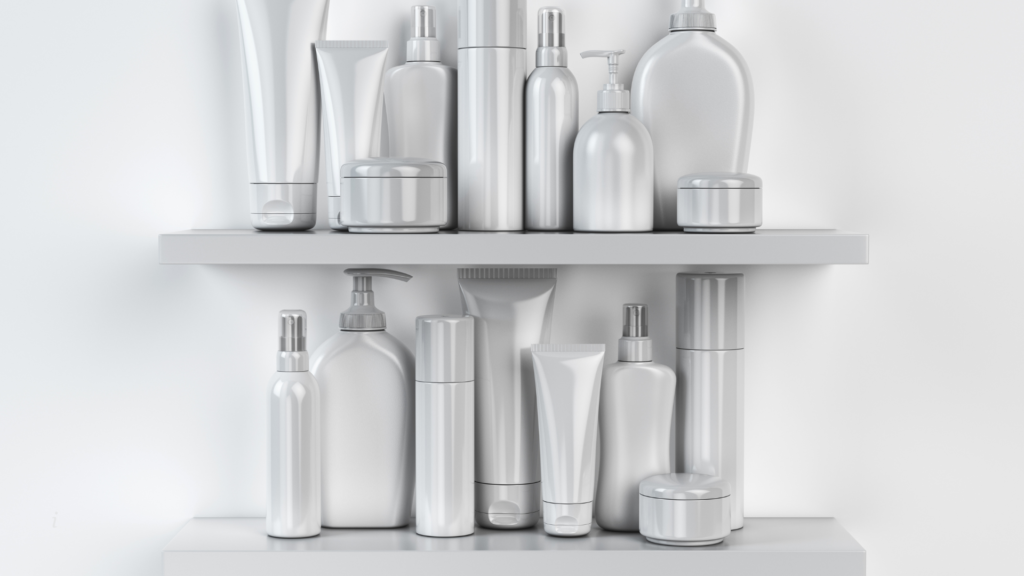
You know the one. Half-empty bottles, broken promises, and a shelf that never empties.
There’s an old saying about alcohol… “It doesn’t give you the answer — it just makes you forget the question.”
You have a shelf. Maybe not a real shelf. Maybe it’s a drawer. Or a bag under the sink. Or that spot in the bathroom you don’t open anymore.
There’s something in there. Half-empty tubes. Creams with loose lids. A bottle you bought because it promised something, and used three times, because it didn’t deliver.
You replaced it with a new one. The new one worked. At first.
That’s not random. That’s a business model.
198 billion dollars. That’s what the global skincare market is worth in 2025. It grows every year. Not because people get better skin — but because people keep switching products.
Women use an average of 5 products on their face. Every day. 74 percent use at least 3 in the morning. And when something stops working, they buy new. Not because they’re foolish. Because the system is built so that they will.
Think about it… if the products worked permanently, the industry would shrink. It doesn’t. It grows by billions. Every year.
My mother’s sister had bad skin. Everyone in the family knew it. She tried everything there was to try back then — and there wasn’t much. Her generation didn’t have ten-step routines. They had soap and hand cream.
She struggled anyway. And her daughter struggled. And her granddaughter is still struggling. Three generations. None of the bottles gave the answer.
Maybe because the bottles were never designed to solve the problem. Maybe they were designed to make you forget the question.
The “Korean ten-step skincare routine” wasn’t invented by Korean women. It was invented by the American magazine Into The Gloss in April 2014. Charlotte Cho, a Korean-American beauty expert, put together a picture-perfect routine, posted it — and the internet exploded.
Most Korean women don’t follow ten steps. Dermatologists call it overkill. And a growing number of skin doctors now diagnose “cosmetic intolerance syndrome” — skin that has become reactive because it’s been given too many products.
The skin didn’t get better from ten steps. It got confused.
In 2026, dermatologists talk about “skinimalism.” Fewer products. More targeted. Many patients’ chronic skin troubles — persistent acne, constant sensitivity, redness that won’t go away — don’t come from a lack of care. They come from too much care.
It’s not new. It’s what your grandmother knew. She just didn’t give it a fancy name.
And this isn’t a product line. I make soap. Six kinds. Eighty-nine kroner each.
I don’t have a cream. I don’t have a serum. I don’t have a “skincare routine” with seven steps and an app.
It’s not because I can’t. It’s because I won’t. The more products, the more ingredients. The more ingredients, the more triggers. The more triggers, the more reactive skin. The more reactive skin, the more products.
You already know the carousel from your hair. It runs on the skin too.
The next five posts are about what your skin actually does — and what happens when you let it do it.
You can step off anytime. No judging looks.
But if you stay — then we ask the question. The one the bottles made you forget.
Sources
- Statista, “Skin Care Worldwide” (2025) — $198 mia. marked
- Drive Research, “Skincare Statistics and Trends” — 5 produkter/dag, 74% bruger 3+ om morgenen
- Into The Gloss, april 2014 — oprindelse af den vestlige 10-trins rutine
- 100% Pure, “Why Dermatologists Say Skinimalism Isn’t Just a Trend” (2025)
- MedReport Foundation, “The Dangers of Excessive Skincare”
- Clinics in Dermatology, “Management of Cosmetic Intolerance Syndrome” (1988) — begrebet introduceret af Maibach