
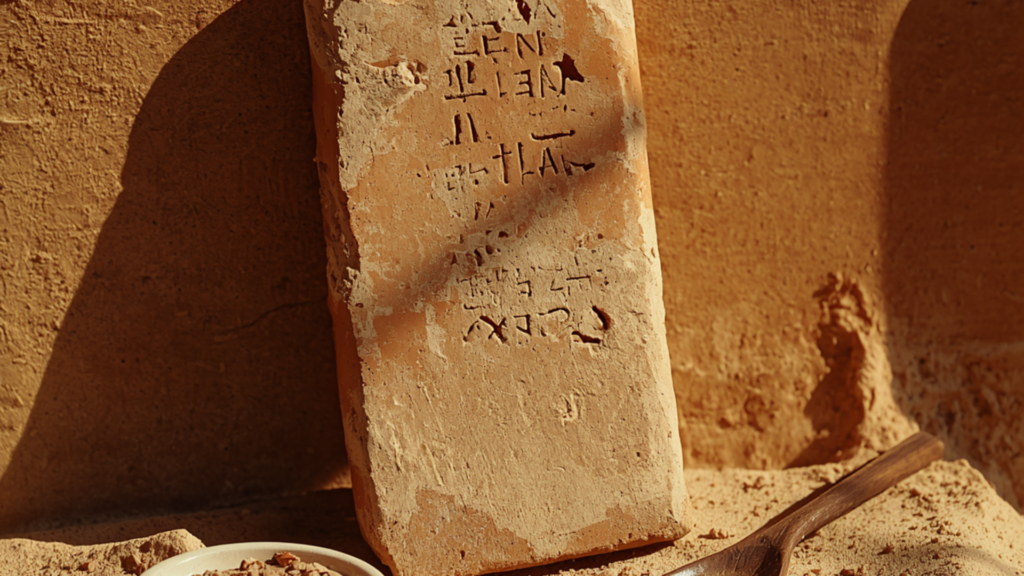
The oldest written soap recipe was scratched into clay 2,800 years before Christ.
2,800 years before Christ. Between the Tigris and the Euphrates. Someone — we don’t know who — writes on a clay tablet:
One part ash from burned barley straw. Three parts cypress oil. Mix.
That’s it. That’s soap.
It’s also the first written chemical reaction in human history. Older than most writing systems. Older than the pyramids. Older than Danish existed as a language at all.
The Babylonians didn’t use the soap on their bodies. They washed wool with it. For washing the body they had other traditions — oils, salves, scraping. But the recipe — a fat plus an alkaline ash — is the same basic formula we still use today.
4,800 years later, in a Danish basement, I mix beef tallow together with lye. It’s the same reaction. We just have better thermometers.
That’s the only meaningful difference between their cleaning and ours: we have the choice. The Babylonians had what they had. Barley-straw ash, because they built with barley. Cypress oil, because cypress grew there. Three numbers in a ratio — one to three — because someone had worked out that it worked.
This series is about the 4,800 years that follow. How three ingredients became an industry. What was lost along the way. And what wasn’t.
Sources og noter
- The Archaeologist (2024) — The Invention of Soap in Ancient Babylon
- Wikipedia — Soap — Babylon-oprindelse, kontinuitet
- American Cleaning Institute — Soaps & Detergents History
- SoapHistory.net — 2800 f.Kr. opskrifts-detaljer
- Bygstrå-aske + cypres-olie 1:3-forhold: lertavle-fund fra Mesopotamien. Brugt til uld-vask, ikke krop.