
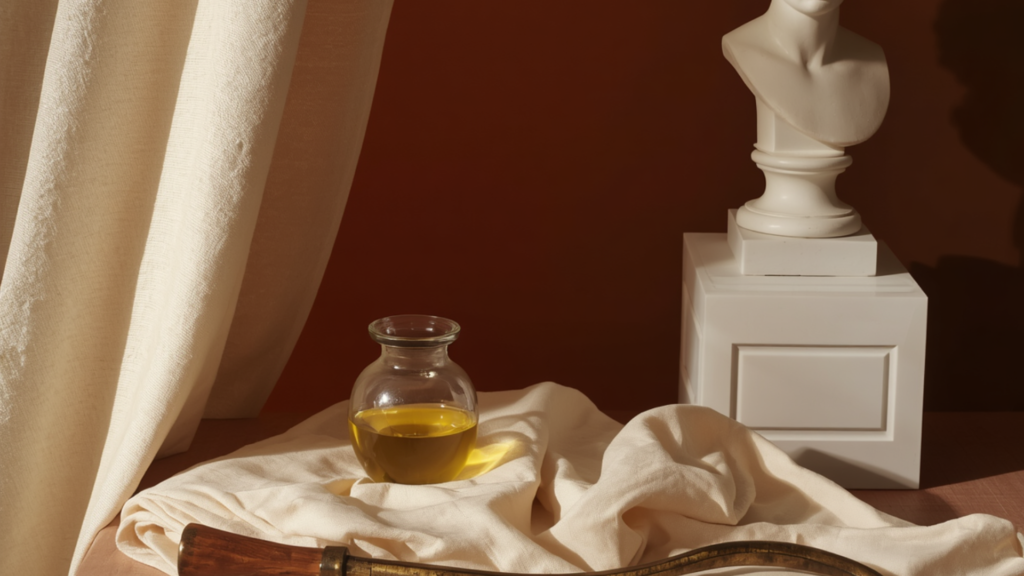
The Romans had a high bathing culture. They just didn’t have soap.
It’s one of history’s funny points.
The Romans, who built aqueducts and thermal baths across the empire, didn’t make soap.
They rubbed themselves with olive oil. Sweated in the public baths — tepidarium, caldarium, frigidarium. And scraped the oil, the sweat, and the dirt off the skin with a strigil. A curved metal scraper.
It was a high culture. It was clean. But it didn’t involve soap.
Soap came from the “barbarian” peoples north of the border. Pliny the Elder wrote in Naturalis Historia, first century after Christ:
“Soap — an invention of the Gauls, for making their hair shiny. Made from tallow and ash, the best from beech ash and goat fat. Among the Germanic peoples it’s used more by men than by women.”
The Gauls and the Germanic peoples made soap. To make their hair light and glossy. The men used more of it than the women.
That’s not the picture we have of “our ancestors in Northern Europe.”
The first documented medical rationale for soap came from the Greek physician Galen in the second century. He recommended Germanic soap. He thought it was the best. That’s roughly when soap begins to move from craft to medicine — from something the barbarians made to something the civilized wrote recommendations about.
That lesson we still haven’t quite digested. We still invent “new” skincare and forget that the Germanic men of the year 100 had already worked out that fat plus ash plus water was good for them.
Sources og noter
- Wikipedia — Plinius den Ældre, Naturalis Historia)
- Wikipedia — Strigil — romersk bade-praksis
- Wikipedia — Galen — medicinsk rationale, 2. århundrede
- American Cleaning Institute — Soaps & Detergents History
- Citat fra Plinius: bøgeaske + gedefedt, mænd > kvinder. Naturalis Historia bog XXVIII.