
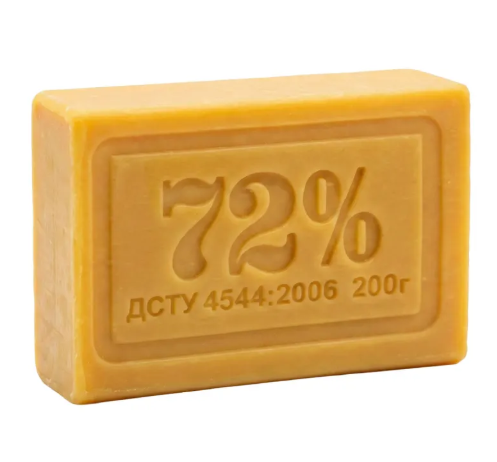
My great-grandmother had a large, brown bar of soap. It was for laundry, dishes, stain removal, floor washing — and incidentally also for washing yourself, if she ran out of the white one. But then again, the woman had lived through at least three wars. She wasn’t delicate. The brown one smelled of something indeterminate — not particularly pleasant, but extraordinarily effective. It was quite large for my hands to grip, and I dropped it seventeen times before I finished the dishes. When it eventually got too small to hold, you could collect the remnants, wet them, and press them together in the soap dish. Overnight they’d dry and fuse, and you were back in business.
And it wasn’t because she didn’t have access to “the modern.” My mother had the best intentions when she dragged in the prettiest bottles: “just pour,” “just spray,” “just squeeze.” She was allowed to drag them back home again.
My great-grandmother saw nothing but chemical smells, fiddly lids, and eventually an empty container. She knew nothing about the environment, chemistry, or pollution. She could barely read or write. But she knew something the rest of us have forgotten — a home doesn’t need to smell of “ocean breeze” to be clean.
There are plenty of people who skip fabric softener with the explanation — “it’s chemicals.” The rest of what’s in their laundry room is too — but that doesn’t seem to stop them. So it’s not really about the fabric softener being chemicals. They’ve simply decided that particular chemical is unnecessary.
But how much chemistry is “necessary”?
The cleaning aisle in a supermarket today looks almost like a toy shop. There is genuinely a bottle for nearly every single surface. I have never understood what scrubbing cream is for. Can someone explain that to me? If something is so stuck that it won’t come off with a pot scrubber and hot water, what will the liquid “scrub” do? Maybe I’ve never given it enough of a chance — but if it actually works, shouldn’t we in principle not care about “how”?
Why does a ceramic hob need its own bottle? It’s just glass. And it’s not even the royal china.
And something new comes out all the time — “better formula,” “more effective”… Right. Does that mean we can finally eat off our floors?
Have our homes become so much dirtier? Or have we just been so thoroughly sold on the idea?
The dictionary defines “clean” as also meaning “that which does not emit substances harmful to the organism or the environment.” Modern cleaning products cannot live up to that description.
Which means we are, in principle, using something that is not “clean” — in order to achieve… cleanliness. Is it just me who finds that interesting?
But there is a price to be paid for “modern cleanliness.”
I’ll come back to that in the next posts — because they almost deserve a chapter of their own.